Power Distribution & High-Voltage Board Redesign
Four-layer power distribution and high-voltage PCB redesign for an autonomous soccer robot
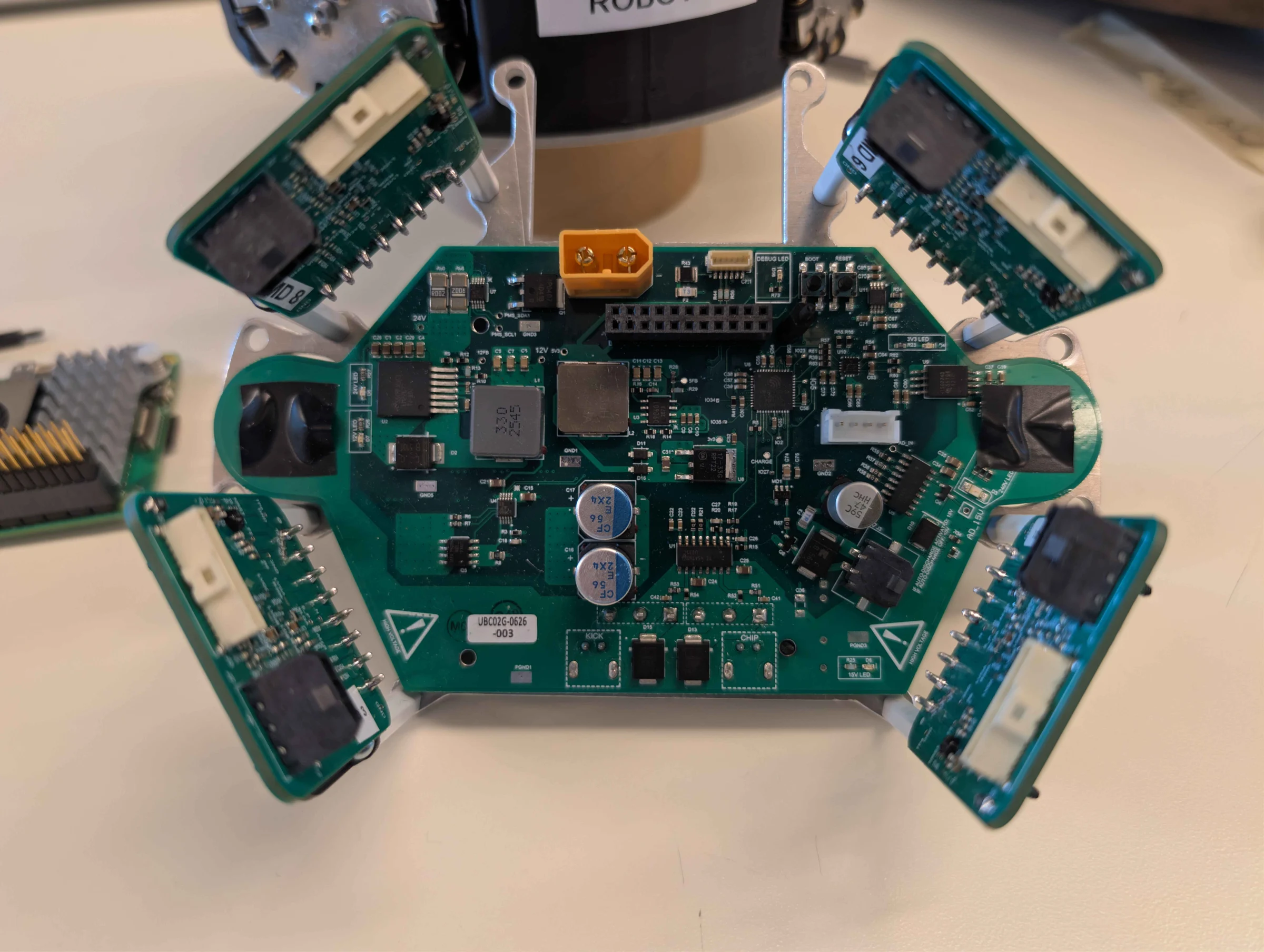
I worked on a layout-focused redesign of the board that distributes power across the robot and supports its high-voltage kick and chip system. The revision had to combine multiple regulated rails, an isolated high-voltage domain, embedded interfaces, and new support circuitry within changing mechanical constraints.
My scope: PCB layout redesign, integration of new schematic blocks, connector and interface routing, isolation-aware placement, and planning for board bring-up and validation.
- System input
- 24 V battery
- Power domains
- 5 regulated rails
- Board stackup
- 4 layers
The redesign challenge
The existing powerboard needed a new revision for both electrical and mechanical reasons. Switching-converter noise concerns—especially around the flyback stage—made layout a central design problem, while robot packaging changes required several connectors to move.
The previous revision also exposed too few useful test nodes. The redesign therefore had to do more than fit the circuits: it needed to make power conversion, isolation, and system interfaces easier to inspect during bring-up.
- 01Fit updated connector locations and robot geometry
- 02Maintain separation between low- and high-voltage domains
- 03Route multiple regulated rails and communication interfaces
- 04Improve access to converter and feedback test nodes
- 05Reuse proven portions of the previous design where practical
- 06Support a prototype-first validation workflow
Mixed-voltage power tree
A 24 V robot battery feeds a mixed-voltage power tree. The board combines conventional low-voltage rails for control electronics with isolated support power and a flyback stage for the capacitor-charging system.
- 12 V buck rail
- 5.3 V buck rail
- 3.3 V LDO rail
- Isolated 12 V → 15 V DC/DC
- Isolated gate-drive supply
- Isolated feedback path
- Flyback converter
- 240 V design rail
- Kick and chip capacitors
Galvanic isolation
The high-voltage capacitor-charging circuitry and the low-voltage controller cannot share an unrestricted electrical domain. The design therefore uses galvanic isolation at the power, drive, and measurement boundaries.
- MCU and logic
- USB-to-UART
- Power monitoring
- Robot communication interfaces
- Flyback transformer
- Isolated 12 V → 15 V converter
- Isolated gate drivers
- Isolated feedback amplifier
- Flyback power stage
- 240 V rail
- Kick / chip capacitor outputs
- High-voltage feedback node
On the four-layer PCB, power and ground regions were split between the high- and low-voltage domains so that copper geometry supported the intended isolation architecture.
Flyback layout focus
The flyback converter was the main layout focus because it creates the high-voltage rail used to charge the kick and chip capacitors. Fast switching edges and pulsed current paths make physical placement and loop geometry part of converter behaviour.
The redesign focused on reducing high-current loop area, improving placement around switching nodes, and making the primary-side circuit easier to probe. Possible snubber changes and primary-side noise remained characterization tasks rather than claimed results.
- 01Keep high-current switching loops compact
- 02Place critical components around the flyback stage deliberately
- 03Separate switching nodes from sensitive control and feedback paths
- 04Preserve the isolation boundary in copper and placement
- 05Expose relevant nodes for oscilloscope measurements
- 06Leave room for measurement-led iteration
Layout principleFor a switching converter, the schematic defines the connections; the PCB determines the physical current loops that actually switch.
New circuits in the revision
The redesign incorporated three new functional blocks while retaining and rerouting existing board functions where practical.
High-voltage feedback
Added an isolated-amplifier feedback path so the low-voltage controller could observe the high-voltage domain without removing galvanic isolation.
Dribbler motor drive
Integrated a dribbler motor-driver block using isolated gate-drive circuitry alongside the existing power functions.
Automatic flashing
Added USB-to-UART auto-flashing circuitry to reduce friction during firmware deployment and debugging.
- UART
- Flashing and debug
- I2C
- Power monitoring
- SPI
- High-voltage sensing interface
- Test points
- Rail and converter access
Designing for testability
Testability was treated as a board-level requirement. Additional headers and test points were added so bring-up could isolate individual converters, feedback paths, and ground domains instead of treating the board as one opaque system.
- Added access to flyback and buck-converter nodes
- Made critical rails easier to probe
- Added debug and programming access
- Kept prototype circuitry accessible for rework
- 01Bring up low-voltage rails before enabling the high-voltage stage
- 02Check separation between isolated ground domains
- 03Measure flyback switching behaviour and primary-side noise
- 04Verify the isolated high-voltage feedback path
- 05Evaluate whether snubber changes are required
- 06Confirm system interfaces after mechanical integration
Board implementation
The resulting four-layer layout combines power conversion, embedded control, isolated sensing, motor-drive support, communication interfaces, and high-voltage capacitor connections on one mechanically constrained board.
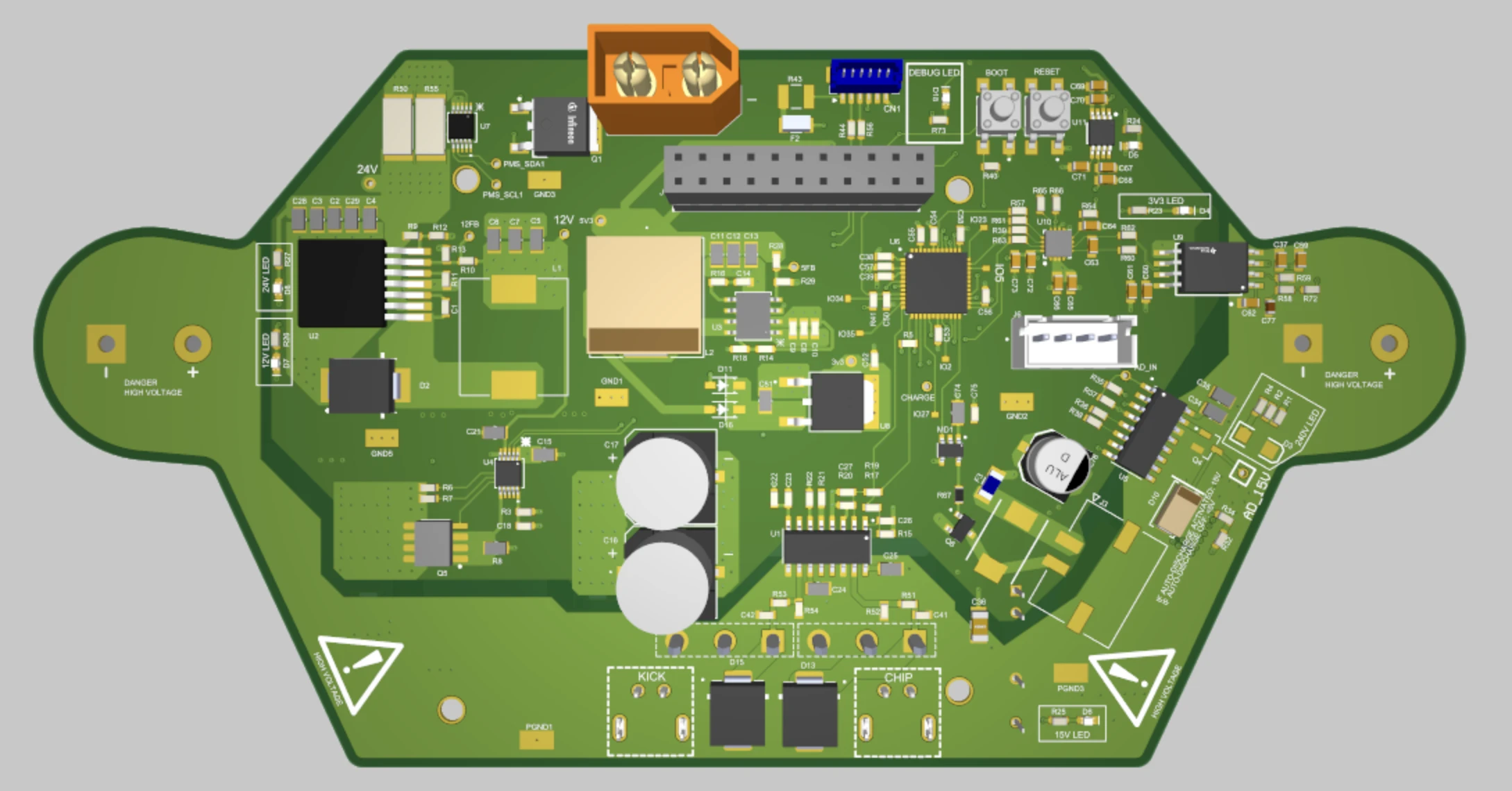
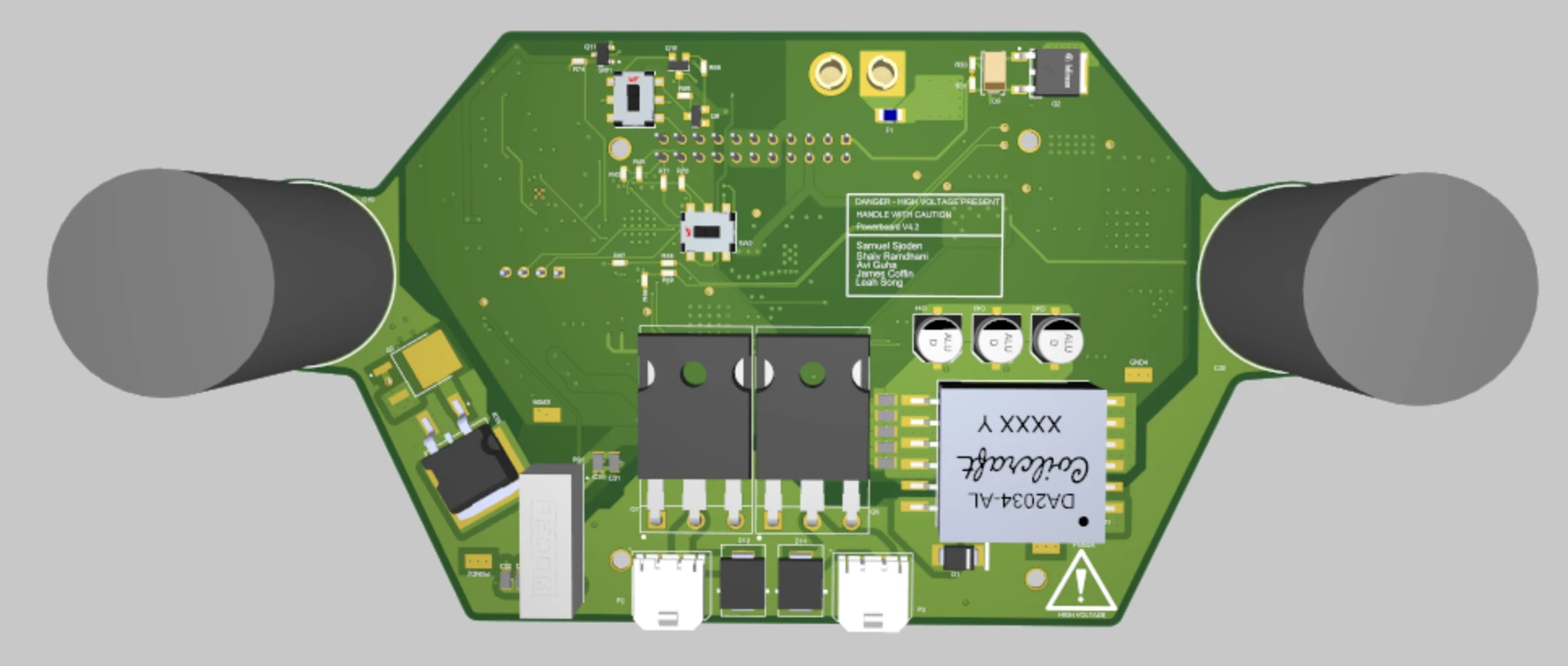
The front render shows the dense low-voltage control and conversion circuitry alongside clearly marked high-voltage outputs. The back render exposes the larger power components and makes the physical separation between functional regions easier to see. This revision was designed to support prototype validation; the renders do not by themselves establish electrical performance.
Engineering lessons
- 01
Layout is part of the converter
Switching-loop area, placement, and return paths influence flyback behaviour just as much as the schematic connections.
- 02
Isolation must be physical
Galvanic isolation has to remain visible in power routing, ground regions, component placement, and measurement interfaces.
- 03
Design for bring-up
Test points and accessible internal nodes reduce the time between observing a bad rail and finding the relevant circuit.
- 04
Mechanical changes propagate
Moving connectors affects routing, current paths, serviceability, and how the board integrates with the complete robot.
- 05
Integrate interfaces deliberately
UART, I2C, SPI, sensing, and power routing have different constraints even when they share the same PCB.
- 06
Prototype around uncertainty
Reusing stable circuitry while exposing new blocks for measurement made the next validation steps clearer and lower risk.
The redesign produced a board revision with the new feedback, motor-drive, auto-flashing, connector, and test-access changes integrated. However, after integrating this board into our robot there were errors to be addressed. Next years revision will tackle these.